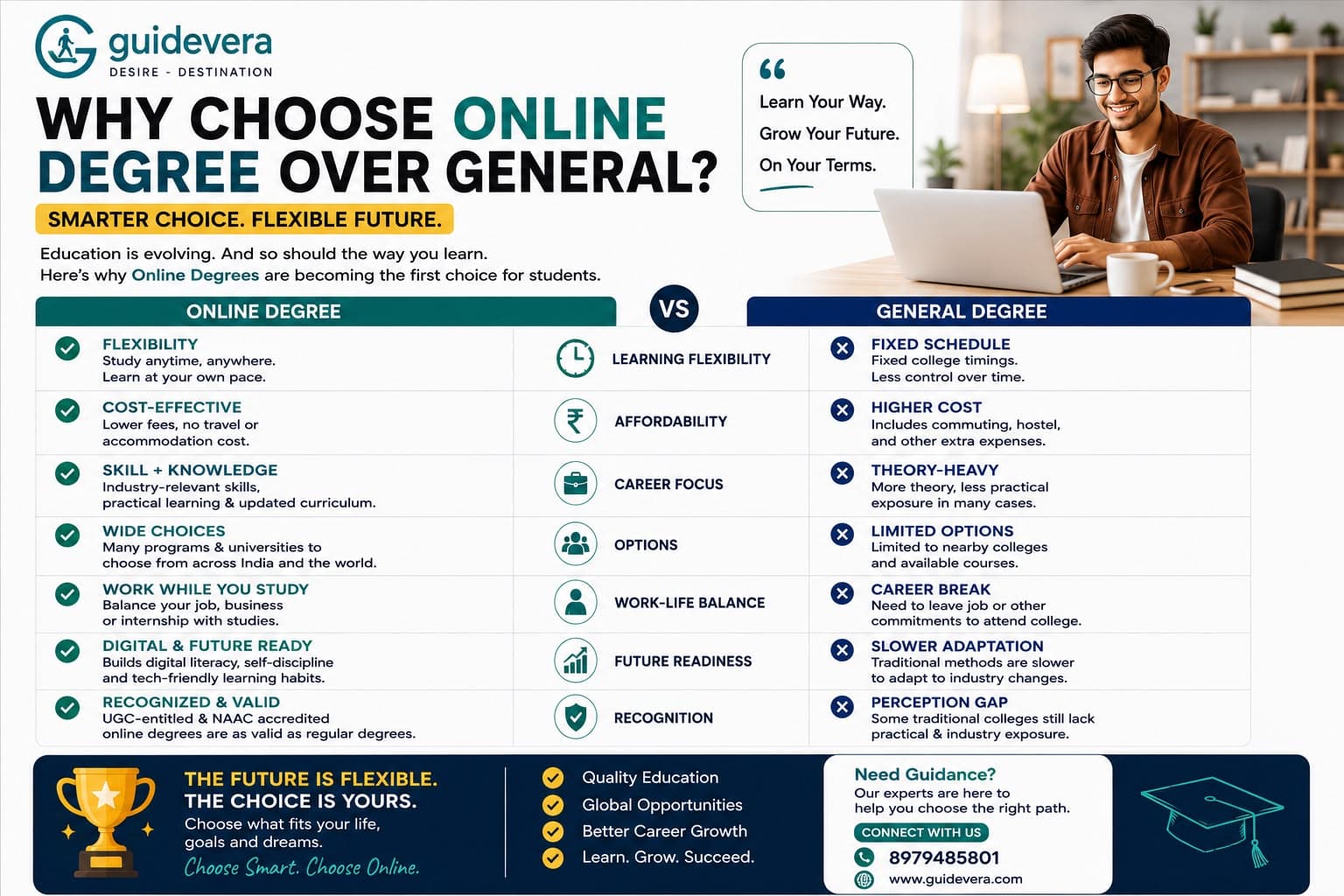
Why Choose an Online Degree Over a General Degree in 2026?
Education is evolving — and so is the way ambitious students choose to learn it. For decades, a “general degree” (the traditional, on-campus route) was the only real option. Today, UGC-entitled online degrees from recognized universities have changed that equation completely, giving students a genuine second path to the same destination.
Whether you're a working professional trying to build a qualification without pausing your career, a student in a smaller city wanting access to a top-tier university, or someone who simply learns better at their own pace — an online degree isn't a compromise anymore. In several ways, it's the upgrade.
In this guide, we break down exactly how an online degree compares to a general degree across the seven factors that matter most — so you can decide based on facts, not assumptions.
Key Fact: A UGC-entitled online degree is legally equivalent to a regular campus degree in India — valid for government jobs, private sector employment, higher studies (like an MBA) and professional certifications. Always verify UGC-DEB entitlement before enrolling.
Online Degree vs General Degree — Quick Overview
Factor | Online Degree | General Degree |
Learning Flexibility | Study anytime, anywhere, at your own pace | Fixed college timings, less control over time |
Affordability | Lower fees, no travel or accommodation cost | Higher cost — commuting, hostel & extra expenses |
Career Focus | Industry-relevant skills, practical, updated curriculum | More theory-heavy, less practical exposure |
Options | Wide choice of programs & universities across India/world | Limited to nearby colleges and available courses |
Work-Life Balance | Study while working a job, business or internship | Usually requires a full career break |
Future Readiness | Builds digital literacy, self-discipline, tech habits | Traditional methods, slower to adapt to change |
Recognition | UGC-entitled & NAAC accredited — valid as regular degree | Recognized, but some perception gap on practical exposure |
1. Learning Flexibility: Study Anytime vs Fixed Schedule
• Online Degree: Study anytime, anywhere, and move through material at your own pace. Missed a lecture because of work? Rewatch it later.
• General Degree: Fixed class timings and fixed college hours, with very little control over how your day is structured around your education.
If your life doesn't fit neatly into a 9-to-5 academic schedule, this alone can be the deciding factor between the two paths.
2. Affordability: Lower Fees vs Hidden Costs
• Online Degree: Tuition is typically lower, with no commuting cost, no hostel fee, and no relocation expense.
• General Degree: The sticker price is only part of the bill — commuting, hostel or PG rent, food and daily incidentals add up fast.
For cost-conscious or self-funding students, this difference compounds significantly over a 2–4 year program.
3. Career Focus: Practical Skills vs Theory-Heavy Curriculum
• Online Degree: Built around industry-relevant skills, practical learning, and curricula updated to match what employers are actually hiring for.
• General Degree: Often more theory-heavy, with a wider gap between classroom learning and real job requirements.
If your goal is employability from day one — not just a certificate — this is one of the most important factors to weigh.
4. Options: A Wider Menu vs Limited by Geography
• Online Degree: Choose from top-ranked institutions across India — and in many cases globally — all from the same laptop.
• General Degree: Choices are capped by which colleges are within commuting or relocating distance, and by seat availability there.
More options mean a better shot at finding the exact program, specialization and university reputation that fits your goals.
5. Work-Life Balance: Study Alongside Your Career vs Career Break
• Online Degree: Balance your job, business or internship with your studies — no need to pause your income or career momentum.
• General Degree: Usually requires a full-time commitment, which often means stepping away from work entirely.
For working professionals eyeing a promotion, a career switch, or an MBA to move up the ladder, this is frequently the single biggest reason they choose online.
6. Future Readiness: Digital-First Learning vs Slower Adaptation
• Online Degree: Naturally builds digital literacy, self-discipline and tech-friendly learning habits — now table stakes in most modern workplaces.
• General Degree: Traditional teaching methods, in many cases, are slower to adapt to how industries and technology are changing.
An online degree doesn't just teach a subject — it trains you in the way of working the modern job market increasingly expects.
7. Recognition: Is an Online Degree Actually Valid?
• Online Degree: UGC-entitled and NAAC-accredited online degrees are recognized as equivalent to regular degrees in India.
• General Degree: Carries no automatic advantage in legal recognition once the online program is properly UGC-entitled.
The only caution: not every “online course” is UGC-entitled. Verifying a university's approval status before enrolling isn't optional — it's the single most important check in the entire decision.
Why Choose an Online Degree in 2026? — 5 Powerful Reasons
1. Study from Anywhere — Access world-class education from Dehradun, Delhi, Mumbai or any city in India without relocating or paying for hostel and campus living.
2. Learn at Your Own Pace — Recorded sessions and flexible schedules are ideal for students who work part-time or manage personal commitments.
3. Affordable Access to Top Universities — Get a degree from a recognized university at a fraction of the cost of a campus program.
4. Better Career Prospects — UGC-entitled online graduates are increasingly preferred by employers who value self-discipline, digital fluency and time management.
5. Upgrade While You Work — Unlike campus programs, an online degree lets you apply what you learn immediately in your job — accelerating both education and career together.
How to Choose the Right Online Degree — Key Factors to Check
Factor | What to Check | Why It Matters |
UGC-DEB Entitlement | Verify at ugcerp.in — must be listed for online delivery | Legally required for degree validity in India |
NAAC Grade | A++ is highest, then A+, then A | Higher grade = better employer acceptance |
Specializations | Match with your career goal | Right specialization opens the right doors |
Placement Support | Active placement cell, company tie-ups, alumni network | Determines job outcomes after the degree |
Learning Platform | Quality of LMS, live classes, faculty access, mobile app | Affects your daily learning experience |
Brand Recognition | How well-known is the university in your target industry? | Brand matters more for first job opportunities |
Online Degree vs General Degree — Which Should You Choose?
Choose Online Degree If… | Choose General Degree If… |
You are working and want to keep earning while you study | You are starting college straight after school with no work commitments |
Cost and flexibility matter more than a campus experience | You specifically want the full residential campus experience |
You want access to top universities regardless of location | You thrive in a structured, in-person classroom environment |
You want a curriculum built around current industry skills | You want daily face-to-face interaction with faculty and peers |
You are self-disciplined and can study without daily supervision | You learn better with fixed schedules and constant structure |
Bottom Line: For self-motivated students, working professionals and those in smaller cities — an online degree from a UGC-entitled university is equally valid and often more practical than a general degree. The key is choosing the right university with proper UGC entitlement and strong placement support.
What Is an Online Degree and Is It Worth It?
An online degree delivers the same curriculum as a regular campus program — through a digital platform, with live classes, recorded sessions, assignments, group projects and virtual mentoring. The subject matter, credit structure, and degree title are the same; only the mode of delivery changes.
In 2026, an online degree from a UGC-entitled university is completely valid across India — for private sector jobs, government job applications, further studies like an MBA, and professional certifications. The growing acceptance of online degrees by employers across IT, Banking, E-commerce, FMCG and Consulting sectors has made this one of the most practical qualification routes for ambitious students today.
Who Should Choose an Online Degree?
• Working professionals who want to upskill or requalify without leaving their job
• Students in smaller cities or towns who want access to top-tier university degrees
• Entrepreneurs and business owners who need a flexible study schedule
• Students who are self-disciplined and comfortable with independent learning
• Anyone prioritizing affordability and ROI over the traditional campus experience
Still Unsure Which Path Is Right for You?
Choosing between an online degree and a general degree — and picking the right university within that choice — depends on your goals, your current commitments, and how you learn best. Every student's situation is different.
Guidevera's expert counselors have in-depth knowledge of both online and campus programs across India. Take the free Guidevera psychometric ability test to understand what path matches your natural strengths — then book a one-on-one session with a Guidevera expert for a personalized recommendation.
Take Free Ability Test — guidevera.com/ability-test
Book Expert Counseling Session — guidevera.com/counseling
Explore UGC-Approved Online Colleges — guidevera.com/online-colleges
Frequently Asked Questions — Online Degree vs General Degree
Q1. Is an online degree as valuable as a general (regular) degree in India?
Yes — a UGC-DEB (Distance Education Bureau) entitled online degree is legally equivalent to a regular campus degree in India. It is valid for government jobs, private sector employment, higher studies and professional certifications. Always verify UGC-DEB entitlement at ugcerp.in before enrolling.
Q2. Will employers accept an online degree the same way as a campus degree?
Increasingly, yes. Employers across IT, Banking, E-commerce, FMCG and Consulting sectors now actively hire online degree graduates, often valuing the self-discipline, digital fluency and time-management skills that online learning builds. The key factor employers check is UGC entitlement and NAAC accreditation of the issuing university.
Q3. Can I do an online degree while working full-time?
Yes — this is one of the biggest advantages of online degrees. Classes are typically recorded or scheduled flexibly, allowing working professionals to study around their job rather than taking a career break.
Q4. Is an online degree cheaper than a general degree?
In most cases, yes. Online degree tuition is typically lower, and there are no additional costs for hostel, commuting or relocation — making the total cost of an online degree significantly lower than a comparable campus program.
Q5. What should I check before enrolling in an online degree program?
Always verify UGC-DEB entitlement, check the university's NAAC accreditation grade, review available specializations, confirm placement support, and assess the quality of the learning platform (LMS, live classes, faculty access) before enrolling.
Q6. Who should choose a general (campus) degree instead of an online one?
Students who are starting college right after school with no work commitments, who want the full residential campus experience, or who learn best in a structured, in-person classroom environment may still prefer a general degree.