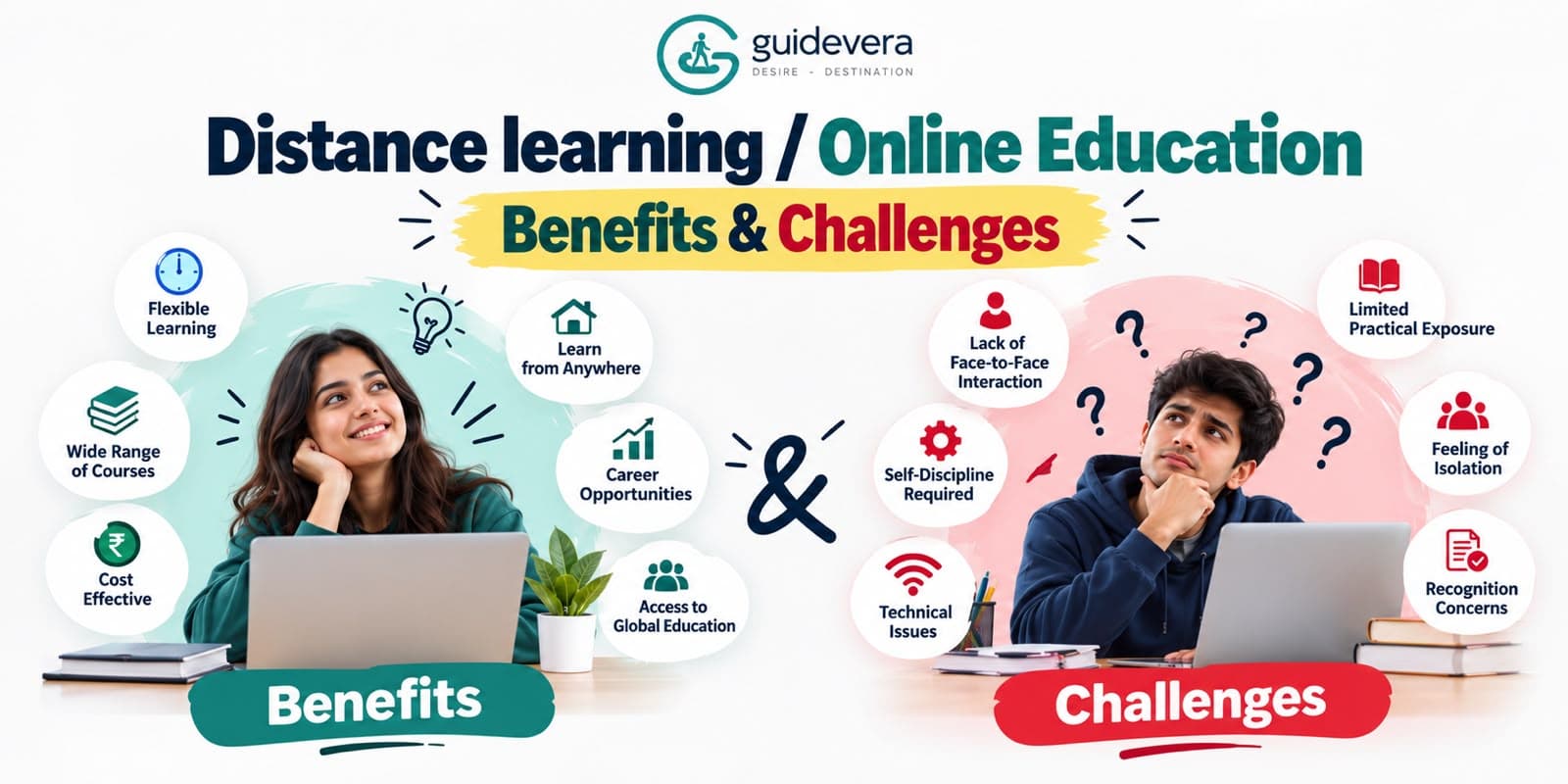
Distance Learning / Online Education in India — Benefits & Challenges (Complete Guide 2026)
A few years ago, a degree meant one thing in India — moving to a new city, attending college every day and spending lakhs on fees, hostel and travel. Today, lakhs of students and working professionals are earning their degrees from home, on their laptop or phone, through distance learning and online education.
But is online education really as good as a regular degree? What are its real benefits — and what challenges should you be ready for before you enroll? In this complete guide, we explain everything a student or parent needs to know about distance learning and online education in India in 2026.
Distance learning and online education allow students to earn a recognized degree without attending a physical campus every day. In India, these programmes are regulated by the UGC Distance Education Bureau (UGC-DEB), and degrees from UGC-entitled universities are equivalent to regular degrees. The main benefits are flexibility, affordability and access; the main challenges are self-discipline, limited interaction and the risk of choosing an unapproved university.
What is Distance Learning / Online Education?
Distance learning and online education are two modes of studying where the student does not need to be physically present in a classroom every day. Although people often use the terms interchangeably, there is a clear difference between them:
1. Open and Distance Learning (ODL)
In ODL mode, students study mainly through self-learning material (printed books or e-books) provided by the university. They attend a few contact classes or counseling sessions at Learner Support Centres and usually appear for term-end exams at a designated exam centre.
2. Online Education
In online mode, the entire programme is delivered over the internet — live classes, recorded video lectures, digital study material, discussion forums, online assignments and online proctored exams. Students can study from anywhere with a stable internet connection.
Factor | Distance Learning (ODL) | Online Education |
Mode of study | Self-learning material + occasional contact classes | Fully internet-based — live and recorded classes |
Exams | Usually at physical exam centres | Online proctored exams from home |
Interaction | Limited — mainly at study centres | Live sessions, forums, chat with faculty |
Device needed | Optional | Laptop / smartphone + stable internet |
Regulator | UGC-DEB | UGC-DEB |
Degree validity | Equivalent to regular degree (if UGC-entitled) | Equivalent to regular degree (if UGC-entitled) |
Is Online Education Valid in India? — UGC Rules Explained
This is the first question every student and parent asks. The answer is yes — provided the university is approved.
"Degrees earned through ODL and online mode from UGC-entitled institutions are equivalent to degrees earned through the conventional mode." — UGC, September 2022
In September 2022, the University Grants Commission (UGC) officially confirmed that undergraduate degrees, postgraduate degrees and PG diplomas earned through ODL and online mode are equivalent to the same degrees earned through regular mode. This decision was taken under Regulation 22 of the UGC (Open and Distance Learning Programmes and Online Programmes) Regulations, 2020.
Every academic year, UGC-DEB releases a list of universities entitled to offer ODL and online programmes. For the 2025-26 session, UGC approved 101 universities and 20 Category-1 institutions for ODL programmes, and over 120 institutions for online programmes. The key things to remember:
• Always check the UGC-DEB website (deb.ugc.ac.in) for the current year's list of entitled universities
• Check that the exact programme you want (e.g. Online MBA, BCA, BA) is approved — not just the university
• Online programmes cannot be offered through franchise or third-party study centres
• Professional courses like B.Tech, MBBS, Pharmacy, Nursing, Architecture and LLB cannot be done in online or distance mode
Benefits of Distance Learning / Online Education
Online education has grown rapidly in India because it solves many real problems that students face with traditional college education. Here are the top benefits:
1. Flexibility — Study Anytime, Anywhere
The biggest benefit of online education is flexibility. You can attend classes, watch recorded lectures and complete assignments according to your own schedule. This makes it ideal for working professionals, homemakers, athletes, and students preparing for competitive exams.
2. Earn While You Learn
With online and distance learning, you do not have to choose between a job and a degree. Thousands of students in India work full-time and complete their BBA, BCA, MBA or MCA online at the same time — gaining both a degree and valuable work experience.
3. Lower Cost of Education
Online programmes are usually far more affordable than regular programmes. On top of lower tuition fees, students save on hostel, relocation, travel and daily living expenses — which often cost more than the fee itself.
4. Access to Top Universities from Any City
A student in a small town in Uttarakhand, Bihar or Rajasthan can now earn a degree from a NAAC A+ or NIRF-ranked university without leaving home. Online education removes geography as a barrier to quality education.
5. Self-Paced Learning
Recorded lectures can be paused, replayed and revised as many times as needed. Students who learn at a different speed get the freedom to understand concepts properly instead of struggling to keep up with a classroom.
6. Wide Choice of Programmes
From BA, B.Com, BBA and BCA to MBA, MCA, M.Com and MA, students can choose from a large range of UG and PG programmes, plus specializations like Data Science, Digital Marketing, Fintech, HR and Business Analytics.
7. Digital Skills and Self-Discipline
Online learners naturally become comfortable with digital tools, video meetings, online collaboration and time management — skills that employers value highly in today's hybrid workplaces.
8. Supported by Government Initiatives
India strongly supports online learning. The National Education Policy (NEP) 2020 promotes online and digital education to reach its target of 50% Gross Enrolment Ratio by 2035. The government's SWAYAM platform has already crossed 4.8 crore enrolments, and students can earn academic credits through SWAYAM courses.
Challenges of Distance Learning / Online Education
Online education is powerful — but it is not right for everyone. Being aware of these challenges helps you prepare for them, or decide whether a regular programme suits you better.
1. Requires Strong Self-Discipline
There is no teacher or classmate pushing you every day. Without proper time management, many students delay lectures and assignments and fall behind. Online learning works best for students who can stay motivated on their own.
2. Limited Face-to-Face Interaction
Students miss out on daily classroom discussions, peer learning and the campus experience. Some learners feel isolated, especially in pure distance mode where interaction is minimal.
3. Internet and Device Issues
Online classes and proctored exams need a stable internet connection and a working laptop or smartphone. In many rural and semi-urban areas, poor connectivity and power cuts remain a real challenge.
4. Fewer Practical and Hands-On Opportunities
Courses that need labs, workshops or clinical training cannot be fully delivered online. This is why programmes like engineering and medicine are not allowed in online mode. Even in management and IT courses, students must put extra effort into internships and live projects.
5. Limited Campus Placement Support
Regular colleges organize campus placement drives. Many online programmes offer only placement assistance or career services. Online students usually need to network actively and build a strong portfolio on their own.
6. Risk of Fake or Unapproved Universities
This is the most serious challenge. Many institutions and agents advertise "online degrees" that are not approved by UGC-DEB. A degree from an unapproved institution may not be accepted for government jobs, higher studies or abroad. Always verify approval before paying any fee.
7. Perception Among Some Employers
Although UGC has made online degrees equivalent to regular degrees, a few employers still prefer candidates from regular programmes for certain roles. The good news — this perception is changing quickly, especially for degrees from reputed NAAC A+ and NIRF-ranked universities.
Benefits vs Challenges — Quick Comparison
✅ Benefits | ⚠️ Challenges |
Study anytime, anywhere | Needs strong self-discipline |
Earn while you learn | Limited face-to-face interaction |
Lower fees + no hostel or relocation cost | Requires stable internet and a device |
Degrees from top universities from any city | Fewer practicals and hands-on training |
Self-paced, replayable lectures | Limited campus placement drives |
UGC-valid degree (if entitled) | Risk of fake / unapproved universities |
Builds digital and time-management skills | Some employers still prefer regular degrees |
Bottom line: Online education is an excellent choice for students who need flexibility, want to work alongside studies, or cannot relocate — as long as they choose a UGC-entitled university and stay disciplined. Students who need hands-on training or a full campus experience may be better suited to a regular programme.
Who Should Choose Online / Distance Education?
Student Type | Is Online Education a Good Fit? |
Working professionals | Excellent — upgrade qualifications without leaving the job |
Students preparing for UPSC / SSC / Banking | Very good — earn a degree while preparing for exams |
Students from small towns | Very good — access top universities without relocating |
Students with financial constraints | Very good — lower fees and no hostel cost |
Homemakers and career restarters | Excellent — flexible schedule to restart career |
Students who want B.Tech, MBBS, LLB | Not possible — these courses need regular mode |
Students who want campus life and placements | Regular programme may be a better choice |
How to Choose the Right Online University — Step by Step
1. Decide your career goal first — take a psychometric ability test to understand your strengths
2. Shortlist programmes that match your career goal (e.g. Online MBA, BCA, BBA)
3. Verify the university and the exact programme on the UGC-DEB website for the current year
4. Check NAAC grade and NIRF ranking for academic quality
5. Compare total fees, EMI options, exam mode and learning platform
6. Check placement assistance, alumni network and industry tie-ups
7. Talk to an expert counselor before making the final decision
Choosing an online degree is as important as choosing a regular college. The right decision starts with knowing YOUR strengths — and then finding a UGC-approved programme that matches them.
How Guidevera Helps You Choose the Right Path
At Guidevera, we believe no student should choose a course or a mode of study blindly. Whether you are deciding between online and regular education, or comparing online universities, Guidevera helps you make a confident, data-backed decision:
• Free psychometric ability test — understand your strengths, interests and career aptitude
• Personalized career report — find the career paths and courses that fit you best
• One-on-one expert counseling — get honest, unbiased advice on online vs regular programmes
• Verified college information — only UGC-recognized, NAAC and NIRF-ranked institutions
Our counselors help you verify UGC-DEB approval, compare fees and outcomes, and build a clear plan — so you never end up with a degree that does not support your career.
Take Free Ability Test — guidevera.com/ability-test
Book Expert Counseling Session — guidevera.com/counseling
Explore Top Colleges — guidevera.com/colleges
Frequently Asked Questions About Distance Learning / Online Education
Q1. What is the difference between distance learning and online education?
Distance learning (ODL) is a flexible mode where students study mainly through printed or digital self-learning material and attend occasional contact classes at study centres. Online education is delivered fully over the internet — live and recorded lectures, e-content, online assignments and online proctored exams. Both are regulated by UGC-DEB in India.
Q2. Are online and distance degrees valid in India?
Yes. In September 2022, UGC confirmed that degrees earned through ODL and online mode from UGC-entitled institutions are equivalent to degrees earned through the regular (conventional) mode. The key condition is that the university must be UGC-DEB entitled for that specific programme in that academic year.
Q3. What are the main benefits of online education?
The biggest benefits are flexibility (study while working), lower cost, no relocation, access to top universities from any city, self-paced learning, a wide choice of programmes, and the chance to earn a UGC-valid degree while building work experience.
Q4. What are the main challenges of distance learning?
Common challenges are lack of self-discipline, limited face-to-face interaction, weak internet or devices, fewer hands-on practicals, limited campus placement support, and the risk of enrolling with an unapproved or fake university.
Q5. Which courses cannot be done through online or distance mode?
Professional programmes that need hands-on lab or clinical training — such as Engineering (B.Tech), Medicine (MBBS), Dental, Pharmacy, Nursing, Physiotherapy, Architecture and Law (LLB) — cannot be pursued through online or distance mode in India.
Q6. How do I check if an online university is UGC approved?
Visit the official UGC-DEB website (deb.ugc.ac.in) and check the list of Higher Education Institutions entitled to offer ODL or online programmes for the current academic year. Make sure the exact programme you want is listed. A Guidevera counselor can also help you verify this.